|
Wildlife Research and Management Pty Ltd provides support to community groups, NGOs, mining
companies and government to deliver effective biodiversity solutions. Our emphasis is on understanding
threatening processes that impact on our native fauna and in working with
local groups to provide practical on-ground outcomes such as improved
management of remnant vegetation, the design and construction of corridors,
or effective predator management to protect native species.
Key skills of staff include the demonstrated
ability to develop and implement funding proposals to government and
regional NRM groups on behalf of or in partnership with community groups
and NGOs; project design, literature review and synthesis, analysis and
review of complex biodiversity issues, survey design, field survey, use of
GIS and remote sensing to further biodiversity goals, and predator
management. We also provide support
and supervision for post-graduate students working in wildlife conservation.
Current projects include:
·
review of translocations
of threatened species of mammals, birds, reptiles and amphibians across
Australia;
·
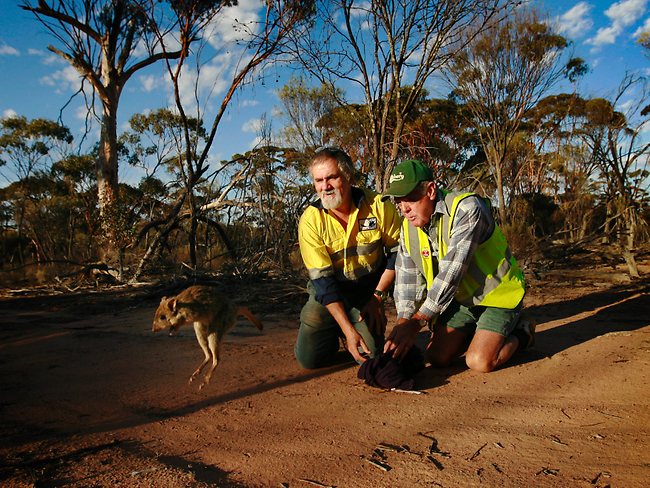
reintroduction of
threatened mammals to Wadderin Sanctuary in the central wheatbelt;
·
reintroduction and
conservation of Shark Bay mammals and management of
Heirisson Prong; and
·
establishing the
distribution and status of the Red-tailed Phascogale in the southern WA wheatbelt and linking this to
improved management of remaining remnant vegetation.
Recently completed projects include:
·
translocation of Rothschild’s Rock-wallaby from a
mine site to surrounding areas of the Pilbara;
·
control of feral
cats in semi-arid
Australia, particularly with respect to the role of alternative prey in
influencing success of control measures.
·
establishing the
distribution and status of Malleefowl in wheatbelt WA and using this information
to develop improved land management both on- and off-reserve.
Other past
projects are drawn from
diverse areas of research and management and include:
·
Historical ecology
– the historical trends in loss of fauna in pre-European Australia;
·
Island ecology –
the distribution, abundance and ecology of mammals on islands;
·
Predator control –
effective control of feral cats and foxes to protect native mammals;
·
Reintroduction of
threatened mammals – restoration of Australia’s ‘lost’ fauna;
·
Landscape ecology
– a critical evaluation of the ‘focal species approach’ to landscape design
·
Landscape ecology
– the role of poison plants (Gastrolobium
spp.) in buffering native mammals from decline in south-west WA.
>> Phascogale project
^ Top
|